
The Learning LOOP
A community supporting learners outside of the classroom
Developed from first-hand experience on both sides of the classroom, the Learning LOOP is built to accelerate progress and develop real fluency over time.
Weekly personalised feedback
Learners submit videos of them signing for personalised feedback about how they can improve
Some of LOOP’s founders’ video submissions as the program was developed

Regular Q&A’s
Weekly Q&As give learners guidance outside the classroom — a space to ask questions, get clarity and keep progressing between lessons.
Learners can submit questions anonymously and receive a weekly recorded response from an expert — available to watch in their own time.
My teacher has told me not to sign 'anyway', but how do I change the subject or move the conversation on without it?
I feel this pressure to sign fast because otherwise I feel like I'm boring everyone...
I feel this pressure to sign fast because otherwise I feel like I'm boring everyone...
I am still struggling with fingerspelling, do you have any tips about how to get better, it gives me such anxiety
My teacher has told me not to sign 'anyway', but how do I change the subject or move the conversation on without it? I feel this pressure to sign fast because otherwise I feel like I'm boring everyone... I feel this pressure to sign fast because otherwise I feel like I'm boring everyone... I am still struggling with fingerspelling, do you have any tips about how to get better, it gives me such anxiety
Weekly virtual sign club
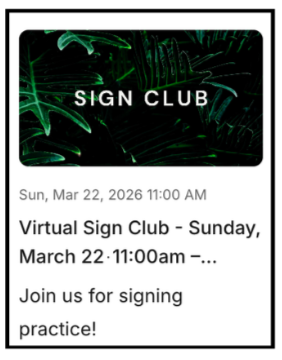
Structured weekly sign clubs where learners work in pairs through guided exercises, switching regularly to practise with different people and build confidence signing with others.
A growing library of content to support learning
Science backed guides on how to learn a visual language, collated content on the learning process and useful resources.
The guides on learning a visual language:
-
The research shows that using spoken English to support BSL learning - through captions, voiceover, or translation - interferes with how a visual language is learned.
This guide explains why watching is not preparation for learning BSL. It is the learning.
-
It is unsurprising that movement plays a central role in learning British Sign Language. Signing supports memory, recall, and confidence, and helps the brain store the language over time.
Research shows that producing signs strengthens learning in ways that watching alone does not. This guide explains how movement supports learning, and how to use it consistently as part of your practice.
-
Accuracy develops over time in sign language learning. It is not the starting point, and it is not a reliable measure of progress in the early and middle stages. Research shows that learners build control, precision, and consistency after signs have become familiar through repetition and use.
This guide explains how errors fit into the learning process, and how progress actually shows up.